The National ID Is Not a Card. It Is a Gate.
NIRA, the Central Bank, and a prime minister’s order are turning Tirsi Aqoonsi into a license for the network. Puntland and Jubaland have already refused the license.
Abdirahman Samawade · 5 min read
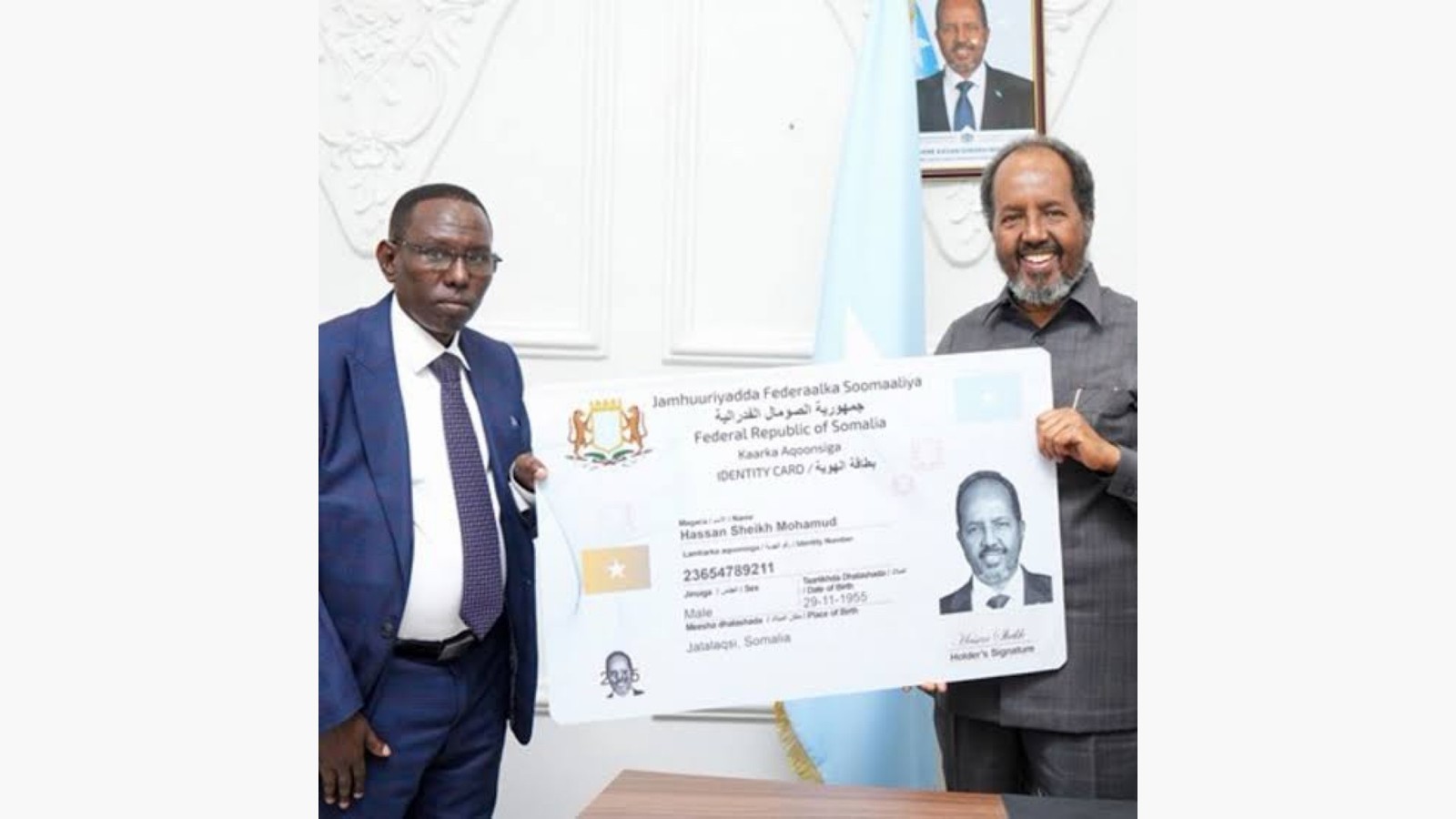
The National Identification and Registration Authority (NIRA) was established under the Identification and Registration Act (Law No. 009 of March 2023). According to its background page, it exists to give every citizen and legal resident a unique National Identification Number — Tirsi Aqoonsi — and a biometric record based on fingerprints and facial recognition.
NIRA describes the number as a unique 11-digit identity, permanently assigned once the holder is confirmed. Issued by NIRA. The design is not unique. Many countries want a single trusted identity for banking, travel, welfare, and civil registration. NIRA lists the same goals: financial inclusion, fraud reduction, authentication for “banking, telecommunications, aviation, and government institutions,” including “SIM card registration” and “secure online transactions.”
On its official use-cases page, NIRA is explicit:
- Telecom providers should ask people to show their National ID to register SIM cards.
- The ID will be used to register for mobile money services and to send or receive remittances.
- National ID authentication is meant to allow “secure mobile money transfers.”
The verification page lists “Telecommunications/SIM registration” among its first use cases, along with the financial sector. That is how the national ID system is built to operate. It is not a card. The federal government is turning the card into a gate — deciding who gets through it, and who is already off the grid.
From a meeting to a banking rule
Prime Minister Hamza Abdi Barre chaired a meeting on ID integration on 7 April 2025 and directed institutions to implement the National ID. “All institutions are instructed to link their services to the National ID System,” reads a line quoted on NIRA’s own news page. He said a detailed directive would follow. Interior Minister Ali Yusuf Ali told the same meeting that linking services to the National ID is part of nation-building.
Then the Central Bank of Somalia made it a rule. On 29 July 2025 the Central Bank, in collaboration with NIRA and the Somali Bankers Association, issued a public notice. With effect from 1 September 2025:
- A valid NIRA ID is required to open a new bank account.
- Renewal of, and updates to, existing accounts require verification of a valid NIRA ID.
The rule was to start in Banadir and then be applied “to the rest of the country.” CBS marketed it as anti-fraud and financial integrity. The Bank also announced the rule on X.
Somalia is a country where mobile money is more pervasive than branch banking, so the obvious next step is to extend the same requirement to SIMs and wallets. NIRA has already written that into its official use cases. When telecoms and mobile-money operators are required to link each line and wallet to a NIRA number, the ID stops being a convenience. It becomes a license to be on the network. Puntland and Jubaland have already rejected the license.
Two interior ministries said no
This is not an academic debate. Two federal member states have rejected NIRA by name.
In March 2025, Puntland’s Ministry of Interior announced that it does not recognize any federal law imposed without prior agreement. It called the registration “a political maneuver that is designed to sustain illegitimate elections,” a distraction from insecurity and national unity, and a threat to data security. The data, it said, was “neither secure nor protected from unreliable hands.” Aid recipients were told to stay away. Puntland would have its own ID.
Then came Jubaland. Its Ministry of Interior said it rejects the so-called National Identity Card because it lacks legal consensus. Officials called the project a tool “aimed at advancing political interests” and told residents not to join activities contrary to Jubaland law.
Those are not think-tank opinions. They are interior-ministry posts from the two states furthest from Mogadishu’s political settlement.
How a useful card turns into a weapon
Somalia fails all three tests at once
A national ID only works if all citizens can get one, if the law and the database are agreed, and if the database cannot be used to deny services to opponents.
NIRA is a federal institution, established by federal law, based in Mogadishu, and now written into Central Bank regulations and a prime ministerial integration order. Puntland and Jubaland say they reject the law and will not run the registration. If the Federal Government then mandates a NIRA card for SIM registration and mobile-money KYC, it closes a loop around residents of those states.
- Their own governments warn them not to register with NIRA.
- Federal regulators and nationwide carriers can deny a SIM or a wallet without a NIRA number.
- Without a SIM and a wallet — the two tools that now carry most Somali remittances and daily communication — you are off the network.
This is not science fiction. It is what happens when you mandate one federal credential on private infrastructure the whole country already lives on. The Federal Government does not have to force a network shutdown. It only has to define what counts as a valid identity — an identity its rivals do not issue — and force banks and telcos to comply.
Puntland’s interior ministry had already called the project political, a way to shape elections without consensus. Jubaland called it a political tool. The claims may be self-interested. They are also a warning about the incentives. Biometric registration, SIMs, and payment KYC are centralizing instruments in a fractured federation. You can count voters with them. You can police movement. You can exclude a region from the cash system under the heading of “compliance.”
None of that is an argument against a Somali ID. Without identity you cannot have clean payrolls, you cannot have elections, and you cannot have correspondent banking. The card, used well, is a public good. It is dangerous because the authority issuing it is in a constitutional dispute — and is being wired into phones and banks before that dispute is settled.
The simple test of an ID is this: can a resident of Garowe or Kismayo keep a phone and a mobile wallet without first accepting a political credential issued in Mogadishu? If not, it is a fulcrum. The construction of that fulcrum is already visible in NIRA’s own documents, the Central Bank’s notice, the prime minister’s integration order, and the refusals of Puntland and Jubaland.
By Abdirahman Samawade · Political analyst